




Table of Contents
◉Definitions You’ll Actually Use (Without the Legal Fog) ◉Why Augusta Gold’s Late-March 2025 Amendments Are a Great Learning Example ◉Step-by-Step: How to Analyze Augusta Gold’s 8-K Debt Amendments Like a Pro ◉Mini Case Study: What a “Schedule A” Structure Changes in Practice ◉Pros, Cons, and Risk Management: How to Think About Debt Amendments Rationally ◉Common Mistakes + Troubleshooting (Diagnosis → Fix) ◉FAQ ◉Conclusion: Your Repeatable Checklist for Augusta Gold—and Any Future Filing ◉Sources
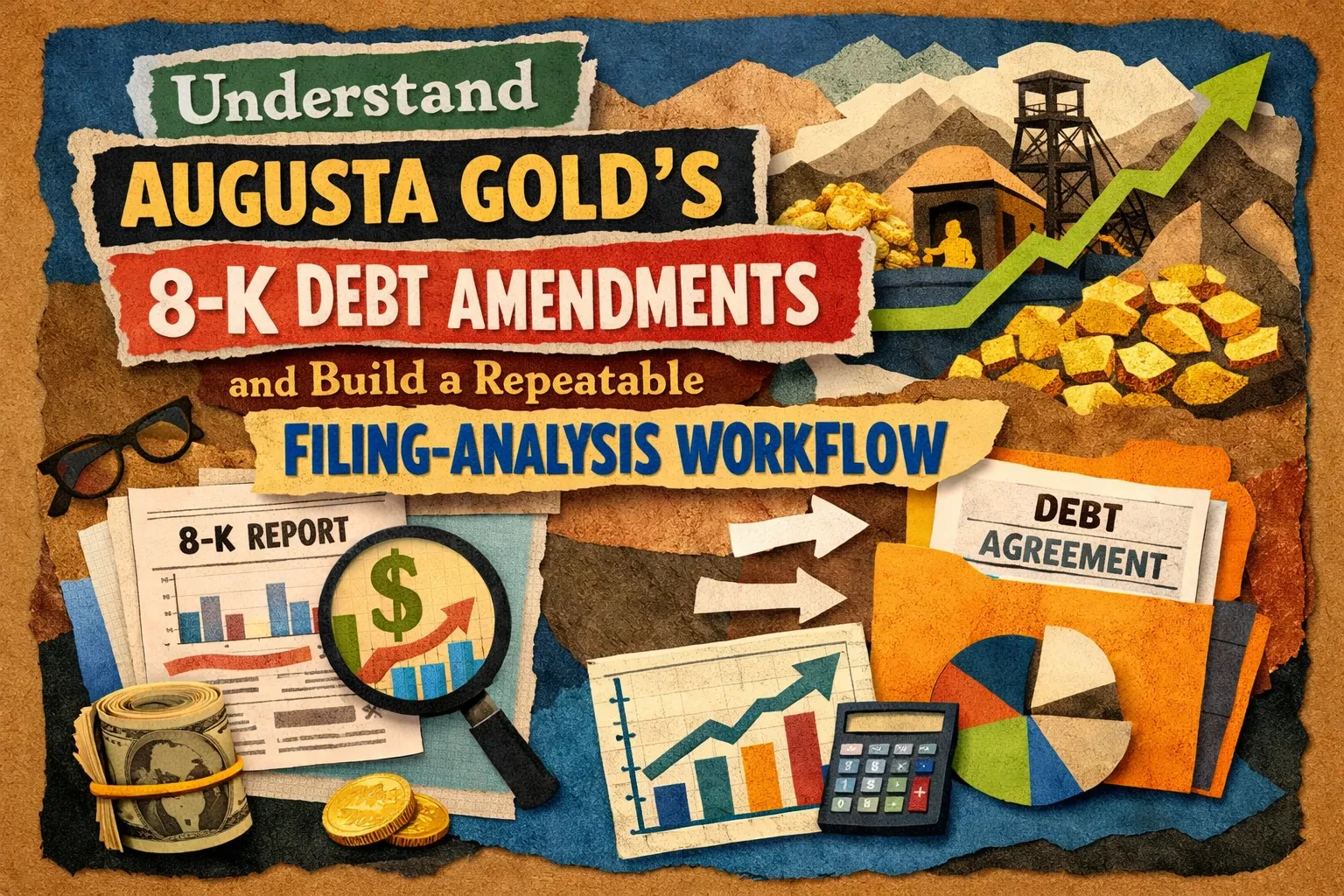
Corporate filings can feel like noise—until they’re the first place you learn a company borrowed more money, changed repayment terms, or reworked a “material agreement” that could affect risk, dilution, or runway. In late March 2025, Augusta Gold disclosed amendments tied to promissory notes—one secured note involving Augusta Investments Inc. and another unsecured note arrangement with Donald R. Taylor. Those are the kinds of updates that often get summarized as “more debt,” but the real story lives in the details: what changed, why it changed, and what it signals about funding options and timing.
This tutorial is for U.S. readers who want a practical, repeatable way to read filings like a pro—without a law degree. You’ll learn how to pull the right documents, map the cash movements, interpret secured vs. unsecured obligations, and create a lightweight tracking system you can reuse for any ticker. Prerequisites: a browser, basic comfort reading contracts (you don’t need to understand every clause), and a note-taking tool or spreadsheet.
Reader Roadmap
• Quick context on Form 8-K and promissory notes so you know what you’re looking at and why it matters (SEC, 2025).
• A step-by-step Augusta Gold walk-through to identify the real changes (not just headlines) (SECDatabase, 2025).
• A “debt amendment checklist” you can reuse for other companies and other filings.
• Common mistakes + troubleshooting so you don’t misread totals, dates, or exhibit language.
• Prompts and templates to summarize filings responsibly with AI while keeping you in control.
Definitions You’ll Actually Use (Without the Legal Fog)
Form 8-K: A “current report” public companies use to disclose major events—often within four business days unless an item specifies otherwise (SEC, 2025). The filing is organized into “Items” (for example, agreements, financial obligations, or other events).
Material definitive agreement: An agreement significant enough that investors would likely consider it important—often reported under Item 1.01 in many 8-Ks (SEC, 2004).
Promissory note: A written promise to repay a debt under defined terms (interest, maturity, repayment mechanics). Notes can be:
• Secured (backed by collateral—specific assets pledged) (Investopedia, n.d.; American Express, 2024)
• Unsecured (no specific collateral—lender relies more on the borrower’s credit and legal claims) (Investopedia, n.d.; CFI, n.d.)
Schedule-based principal tracking: Instead of one fixed principal number, some notes use a Schedule A (or similar) that gets updated as additional advances are made (Justia Contracts, 2025).
Why Augusta Gold’s Late-March 2025 Amendments Are a Great Learning Example
The late-March 2025 disclosure is a classic pattern you’ll see across small and mid-cap companies:
• Additional advances added to an existing financing arrangement (SECDatabase, 2025)
• Language adjusted to allow flexible funding over time and multiple closings (Justia Contracts, 2025)
• Exhibits attached that carry the “real” terms (what changed, how totals are calculated, what documents must be delivered)
Your goal isn’t to become bullish or bearish. Your goal is to understand what changed and what it implies operationally—especially around liquidity and financing constraints.
Step-by-Step: How to Analyze Augusta Gold’s 8-K Debt Amendments Like a Pro
1) Pull the right filing and its exhibits (don’t rely on summaries)
Start by locating the 8-K and verifying you have the exhibits attached. Many key details live in the exhibit PDFs.
In Image 1, you want to see two things clearly: the 8-K “Items” list and the “Exhibits” section where amended agreements are attached. This is where people often stop too early and miss what changed.
What to look for in Augusta Gold’s case:
• A description of amended promissory note documents and any updated schedules (SECDatabase, 2025)
• An exhibit index listing amendments (often an “Amendment No. 1” style document) (SECDatabase, 2025)
2) Identify which “Items” the company used—and why that matters
Different 8-K Items signal different types of events. For debt changes, you commonly see:
• Item 1.01 (entry into a material agreement)
• Item 2.03 (creation of a direct financial obligation)
Companies sometimes reference one item and incorporate details by reference elsewhere (SEC, 2025).
In the March 2025 Augusta Gold situation, the narrative centers on:
• Amending an already-amended secured note structure involving Augusta Investments Inc., including an additional advance (SECDatabase, 2025)
• Amending an unsecured promissory note purchase agreement with Donald R. Taylor to support variable advances and multiple closings recorded on a schedule (SECDatabase, 2025; Justia Contracts, 2025)
Practical takeaway: The Item tells you “what bucket” this is. The exhibit tells you “what changed.”
3) Build a “money movement map” in 3 minutes
Create a simple ledger with three columns:
• Who provided funds
• How much and when
• What document controls the terms
For Augusta Gold (late March 2025):
• Augusta Investments Inc.: an additional advance disclosed in connection with an amended schedule to a secured promissory note arrangement (SECDatabase, 2025)
• Donald R. Taylor: an additional advance disclosed alongside amendments enabling flexible future advances recorded on a schedule (SECDatabase, 2025; Justia Contracts, 2025)
This mapping prevents the most common reader error: mixing up new cash vs. paperwork changes.
4) Confirm whether the debt is secured or unsecured—and what collateral could mean
This is where you translate legal structure into risk mechanics.
• Secured note: typically means specific collateral is pledged; in a default scenario, the lender may have claims tied to that collateral (Investopedia, n.d.; American Express, 2024).
• Unsecured note: no specific pledged collateral; recovery is usually more dependent on general legal claims and the borrower’s solvency (Investopedia, n.d.; CFI, n.d.).
In Augusta Gold’s disclosure, the distinction is explicit: one note is characterized as secured and another as unsecured (SECDatabase, 2025; Justia Contracts, 2025).
Why you care: Secured debt can reduce lender risk—but it can also constrain the company’s flexibility to raise future capital against the same assets.
5) Read the amendment like a journalist: scan for “what changed” first, then “what stayed the same”
Amendments often say: “Except as modified, all other terms remain in effect.” Your job is to find the modifications and ignore the rest.
Use this sequence:
1. Find the amendment section (“Amendment Number One,” “Amended and Restated,” etc.) (Justia Contracts, 2025).
2. Search within the doc for “Schedule,” “principal amount,” “advance,” “closing,” “deliverables,” “maturity,” “interest.”
3. Write down only deltas (what is newly permitted, newly added, or newly defined).
For Augusta Gold’s unsecured arrangement with Donald R. Taylor, the amendment language focuses on:
• The loan amount changing over time and being tracked on a schedule
• Multiple closings on mutually agreed dates
• Updated deliverable documents per closing (Justia Contracts, 2025)
That’s not fluff—it’s the company formalizing a structure to take funds in pieces.
In Image 2, you should be able to point to the exact clauses that describe (a) schedule-based tracking and (b) multiple closings. If you can’t, you’re probably reading a summary rather than the controlling language.
6) Create a “terms snapshot” so you can compare future amendments instantly
Make a one-page snapshot with:
• Principal tracking method (fixed vs. schedule-based)
• Security (secured/unsecured)
• Maturity date and repayment triggers (if disclosed)
• Interest rate mechanics (fixed/variable; payment timing)
• Fees (origination, amendment fees, default interest)
• Any conversion features (convertible debt is a different risk category)
Even if some terms aren’t visible in a short exhibit, your snapshot can still record “not found in this exhibit—check prior filings.”
Augusta Gold-specific note: The public descriptions emphasize that, outside the newly disclosed changes, prior terms remained consistent with earlier documents (SECDatabase, 2025). That is your cue to pull prior versions if you need full term history.
7) Interpret the business signal (without guessing)
Once you have the mechanics, you can infer reasonable signals—carefully:
Possible signals a filing like this can indicate (not guarantees):
• The company is financing operations through repeat advances rather than a single traditional facility.
• Multiple amendments can reflect evolving cash needs or negotiating leverage shifting over time.
• Reliance on a small number of lenders can suggest constraints in accessing broader capital markets.
This is analysis, not certainty—so phrase it that way.
8) Turn this into a repeatable workflow (template included)
Here’s a compact routine you can reuse for any company:
The 15-minute 8-K Debt Check
• Pull the 8-K and list the Items used (SEC, 2025).
• Open every financing-related exhibit; ignore summaries until you’ve read the delta.
• Record: lender, amount, date, secured/unsecured, schedule mechanics, and whether multiple closings are allowed.
• Compare against your last snapshot and mark changes in a “delta log.”
• Add a follow-up reminder: “Check next 10-Q/10-K for totals and liquidity discussion.”
In Image 3, the tracker matters because it forces consistency. You’ll stop losing context when the next amendment arrives.
Mini Case Study: What a “Schedule A” Structure Changes in Practice
A schedule-based note structure is not automatically good or bad—but it changes how you track obligations.
If a note’s principal is updated via a schedule:
• You may need the newest schedule to know the current total outstanding balance (Justia Contracts, 2025).
• The filing can announce “additional advances” while the total principal lives in the schedule attachment.
• Comparing the newest schedule to prior schedules gives you a clean “runway vs. borrowing” timeline.
Practical move: When you see “Schedule A,” treat it like a version-controlled ledger. Save each schedule as a PDF and label it by date so you can compare changes over time.
Pros, Cons, and Risk Management: How to Think About Debt Amendments Rationally
Potential advantages (situational):
• Faster access to incremental capital (multiple closings can reduce timing friction) (Justia Contracts, 2025).
• Avoids renegotiating an entirely new facility for every advance.
Potential risks (situational):
• Increasing debt load can raise financial risk if cash flow doesn’t ramp in time.
• Secured obligations can limit future financing flexibility depending on collateral scope (Investopedia, n.d.; American Express, 2024).
• Concentrated lenders can create dependency and renegotiation pressure.
Risk management for readers:
• Track frequency of amendments and size of incremental advances.
• Watch for new fees, higher default interest, or new collateral language.
• Cross-check the next periodic report (10-Q/10-K) for liquidity discussion and going-concern language.
Common Mistakes + Troubleshooting (Diagnosis → Fix)
Mistake 1: Confusing “amended” with “new money”
Diagnosis: The 8-K says “amendment,” and you assume no cash changed hands.
Fix: Look for explicit language about an “advance,” “loaned,” or “principal amount increased,” then confirm with the schedule/exhibit (SECDatabase, 2025; Justia Contracts, 2025).
Mistake 2: Missing the schedule that contains the real total
Diagnosis: You can’t find a clean total principal in the narrative.
Fix: Search the exhibit index for a schedule attachment (often “Schedule A”) and use that as the authoritative running balance (Justia Contracts, 2025).
Mistake 3: Treating “secured” as “safe” or “unsecured” as “fatal”
Diagnosis: You interpret secured/unsecured as a simple quality label.
Fix: Translate it correctly: secured = collateral claim; unsecured = no specific collateral. Then consider what collateral might constrain in future financing (Investopedia, n.d.; American Express, 2024).
Mistake 4: Ignoring “multiple closings” language
Diagnosis: You assume the disclosed amount is the final size of the facility.
Fix: If the amendment allows multiple closings and variable amounts, treat it as a framework for future advances—then monitor subsequent filings and schedules (Justia Contracts, 2025).
Mistake 5: Over-interpreting intent (“they must be desperate”)
Diagnosis: You jump from “additional debt” to a single narrative.
Fix: Stick to what’s knowable: the structure, amounts disclosed, and what changed. Save broader conclusions for when you’ve reviewed periodic liquidity disclosures.
FAQ
Conclusion: Your Repeatable Checklist for Augusta Gold—and Any Future Filing
You now have a practical way to analyze Augusta Gold’s late-March 2025 debt amendments without getting lost in boilerplate: pull the exhibits, map the money, isolate what changed, snapshot the terms, and track deltas over time. This turns filing-reading from a one-off task into a system you can reuse across companies and quarters.
Quick Checklist (copy/paste)
• Open the 8-K and note which Items were used (SEC, 2025).
• Open every financing-related exhibit and locate “what changed.”
• Record: lender, new advance amount, secured/unsecured, schedule mechanics, multiple closings (SECDatabase, 2025; Justia Contracts, 2025).
• Create/update a one-page terms snapshot and a delta log.
• Set a reminder to cross-check the next 10-Q/10-K liquidity discussion.
Sources
• U.S. Securities and Exchange Commission — Form 8-K (PDF) — https://www.sec.gov/files/form8-k.pdf
• SEC — Current Report on Form 8-K Frequently Asked Questions — https://www.sec.gov/divisions/corpfin/form8kfaq.htm
• SECDatabase — Augusta Gold Corp. Form 8-K (March 2025 exhibit PDF) — https://pdf.secdatabase.com/915/0001013762-25-004133.pdf
• Justia Contracts — Amendment to Unsecured Promissory Note Purchase Agreement (Augusta Gold / Donald R. Taylor) — https://contracts.justia.com/companies/bullfrog-gold-corp-3583/contract/1320905/
• American Express Credit Intel (May 2024) — What Is a Promissory Note? — https://www.americanexpress.com/en-us/credit-cards/credit-intel/what-is-a-promissory-note/
• Investopedia — Promissory Note (definition and secured vs. unsecured context) — https://www.investopedia.com/terms/p/promissorynote.asp
• Corporate Finance Institute — Unsecured Note overview — https://corporatefinanceinstitute.com/resources/commercial-lending/unsecured-note/